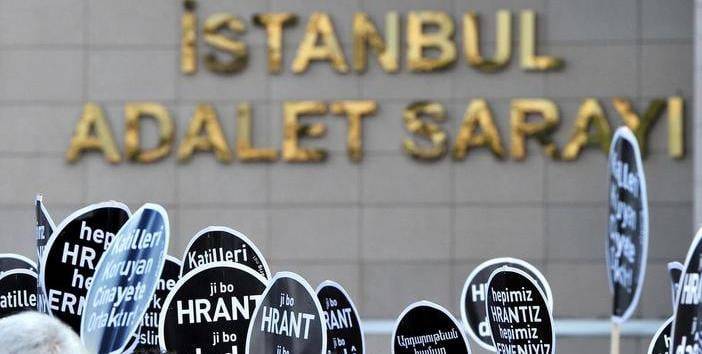

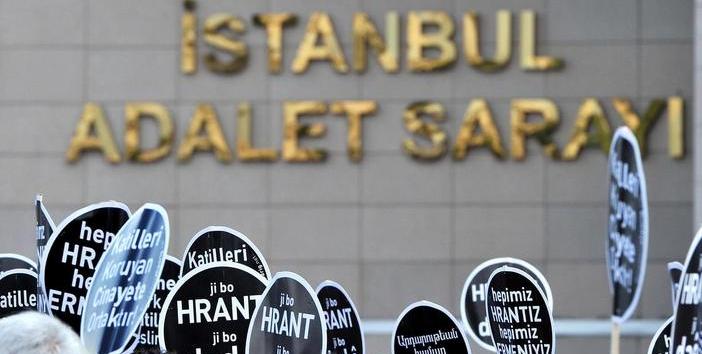
My father, Hrant Dink, was murdered in cold blood on January 19, 2007. He was shot in the back of the head in front of Agos, the newspaper he founded, on one of Istanbul’s busiest streets. Since then, numerous investigations and trials have been conducted in connection with this crime. Some cases have been merged, while others have been separated. The legal process remains ongoing and far from complete. It is unclear when—or if—it will ever truly come to an end. In many ways, it feels as though we are still at the very beginning.
Those interested in the subject emphasise that, in order to shed light on the murder, the events unfolding in different dimensions must be explained alongside their cause-and-effect relationships. These different dimensions can be defined as follows:
1) The targeting process:
2) The process by which the triggerman and instigators organised the murder.
3) A chain of responsibility involving negligence and cover-up attempts that can be described as 'clearing the way', necessarily involving public officials and encompassing both the period before and after the murder.
It cannot be said that the public will be convinced unless the connection between these actions, which take place in these three dimensions and are carried out by many different subjects, is established and investigated; and unless those responsible are tried and receive the necessary punishment. Nor can it be claimed that justice has been served.
Let us leave behind a chain consisting solely of facts, the details of which can be accessed from the files if desired.
* Hrant Dink was targeted in a statement issued by the General Staff.
* It is a proven fact that Yasin Hayal and Erhan Tuncel, who arranged the hit, had ties to officers in the Trabzon Gendarmerie.
* The triggerman, Ogün Samast, also had links to the Trabzon Gendarmerie.
* It is known that Veli Küçük, who targeted Hrant Dink prior to the murder, was the founding commander of the Giresun Gendarmerie Regional Command and had ties to the commander of the Trabzon Gendarmerie Regiment, Ali Öz.
* Sevgi Erenerol, another individual who targeted Dink prior to his murder, had established connections with the General Staff.
* Levent Temiz and Kemal Kerinçsiz, who also targeted and threatened Dink prior to his murder, had clear connections with Veli Küçük and Sevgi Erenerol.
* It has since emerged that the MIT threatened Hrant Dink at the Istanbul Governor's Office at the behest of the General Staff.
* After the murder, the Trabzon Gendarmerie announced over loudspeakers in Pelitli that no information should be given to people not wearing official uniforms, as it was a gendarmerie zone.
* It is known that the planned murder was discussed casually among dozens of people and shooting practice was carried out in Pelitli, a gendarmerie zone where many gendarmerie intelligence personnel are stationed.
* It is clear that the Trabzon Gendarmerie forged and destroyed documents in order to cover up the crime.
* It has also emerged from Ali Öz's own statement that he was with the Giresun Gendarmerie Regional Commander on the day he gave the order to prepare the forged documents.
* It has been recorded that Dursun Ali Karaduman, the Giresun Gendarmerie Regional Commander and superior of the Trabzon Gendarmerie Regiment Commander, referred to Hrant Dink as a “traitor”.
* Yasin Hayal's uncle personally informed the gendarmerie before the murder that he had given Hayal money to find a weapon with which to kill Dink.
* To this day, no one outside the Trabzon Gendarmerie knows that the murder weapon was 'Ardeşen-made'. This information appeared in a suspicious gendarmerie document prepared after the murder and before the killer and weapon were caught, and it remains a mystery to this day.
Looking at this, it is clear that the three dimensions mentioned are strongly combined. How could it be otherwise? Considering the connections that have been attempted in some cases through vague and indirect narratives and fabricated testimonies, it is noteworthy that these relationships are not even viewed with suspicion. Furthermore, in his final article, Hrant Dink explained who, when, where, how and why he was targeted and threatened. Where would a prosecutor or police officer begin?
***
Then there's the fact that the killer was caught in just 32 hours. This is being touted as a success story.
Just as Yasin Hayal's brother-in-law told the gendarmerie that he was going to shoot, Ogün Samast's father also informed the police that his son was the shooter.
Thanks to this information, the killer was arrested in Samsun while on his way home. He was found wearing the same clothes he had been wearing when he committed the crime, with his gun beside him and bullet marks on his arm. That's success. Furthermore, the murder of Hrant Dink was celebrated in the police station's tea room with police officers and gendarmes.
They claim they did it 'so he would talk'. What was asked? What was said? Where are the records? How could they treat a child driven to crime like this? These are futile questions directed at a distorted reality and a fragmented universe.
***
Everyone is said to be wondering how such a blatant murder could have been committed and is supposedly searching for answers.
We understand the Gendarmerie's involvement, but what about the police? And what about the Trabzon police, who monitored the preparations? And what about the Istanbul police, who witnessed the threats time and time again?
And what about the media and their process of singling him out?
And what about those in parliament who scream, 'They are stabbing us in the back', from both the opposition and the ruling party?
And what about the entire 'judicial process' that led to Hrant Dink's wrongful conviction, all the way up to the Supreme Court? Are they also the 'General Staff'?
These are the right questions pointing to the right issues. For those familiar with the influence of the 'General Staff' within the state and among different segments of Turkish society, some of these questions can be easily explained. But probably not all of them can be explained. Would it be better if they could all be explained, or is it better for this country that they cannot? I'm not sure.
The statements made through the structure later defined as FETÖ are certainly meaningful. However, as far as I can see, they raise more questions than they answer. Unless, of course, it is described as another branch of the same tree.
In any case, some of the answers will undoubtedly have to be sought in the prevailing climate and mindset.
Some answers may never be found precisely because racism and discrimination are said not to exist in Turkey.
But we — his family, lawyers, colleagues and friends who carried his coffin — will continue to seek answers, or at least to ask questions.
We have never forgotten the story that Hrant Dink told us. For us, for Turkey, for the world, it was not a fairy tale. It was a powerful addition to an epic that has been unfolding since the beginning of time. Now, as tyranny intensifies its reign, the least we can do is keep the possibility of another world alive, patiently and tirelessly. We must not forget what has been done, nor be ashamed of what we have failed to do. We must cling to the truth.