

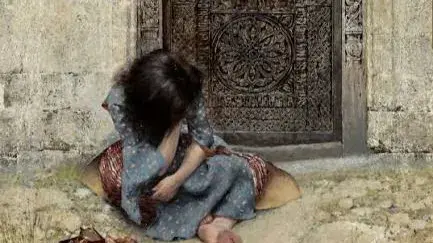
One of the important works of Armenian painter Vardges Surenyants (1860–1921), “The Abandoned” (1894), is being exhibited in Armenia for the first time, more than 130 years after its creation. The international exhibition, titled The Face of Humanity: Surenyants’s “The Abandoned” and Humanist Art, opened on September 17 at the National Gallery of Armenia and marks a significant gathering in the history of Armenian art.
Loaned with the special permission of the Republic of Kazakhstan’s Abylkhan Kasteyev National Museum of Arts, the work is considered an important piece both in Surenyants’s artistic career and in Armenian fine arts.
For the first time, three monumental paintings—The Abandoned (1894), Desecrated Sanctity (1895), and After the Massacre (1898)—are being brought together in the same space, offering a comprehensive view of an important period in the artist’s work.
Another highlight of the exhibition is the historic door of the Church of St. Arakelots at Sevanavank, which Surenyants depicted in “The Abandoned”. The original medieval door, loaned by the History Museum of Armenia, is being displayed alongside the artistic representation of it in the painting for the first time.
An exhibition centered on humanism
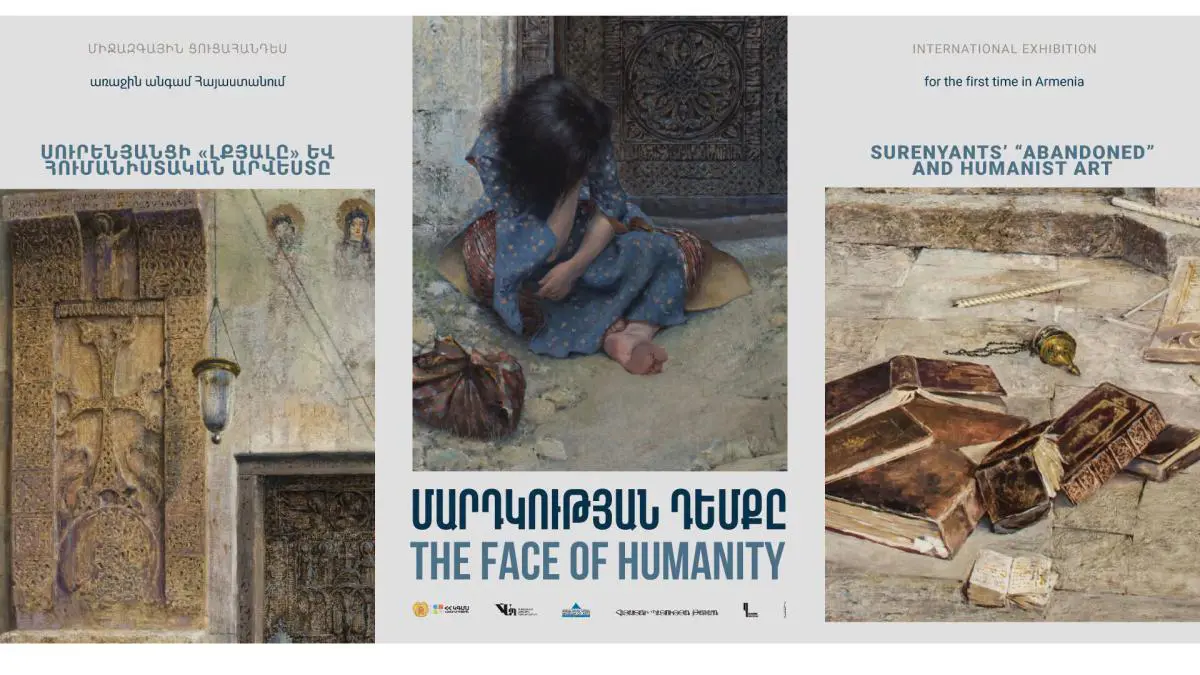 The Face of Humanity exhibition does not focus solely on the past. At the heart of the project are the individual, human dignity, empathy, memory, and our shared responsibility toward humanity.
Created more than a century ago, Surenyants’s works raise questions that continue to resonate today. The exhibition approaches art as a space for human experience, mutual understanding, and dialogue.
The exhibition also features works by artists including Panos Terlemezian, Sarkis Katchadourian, Gerardo Orakian, Mariam Aslamazyan, and Armine Galentz. These works explore the development and continuity of humanist thought in Armenian art.
Curated by Vigen Galstyan, the exhibition will be open to visitors at the National Gallery of Armenia until February 17, 2027.


