


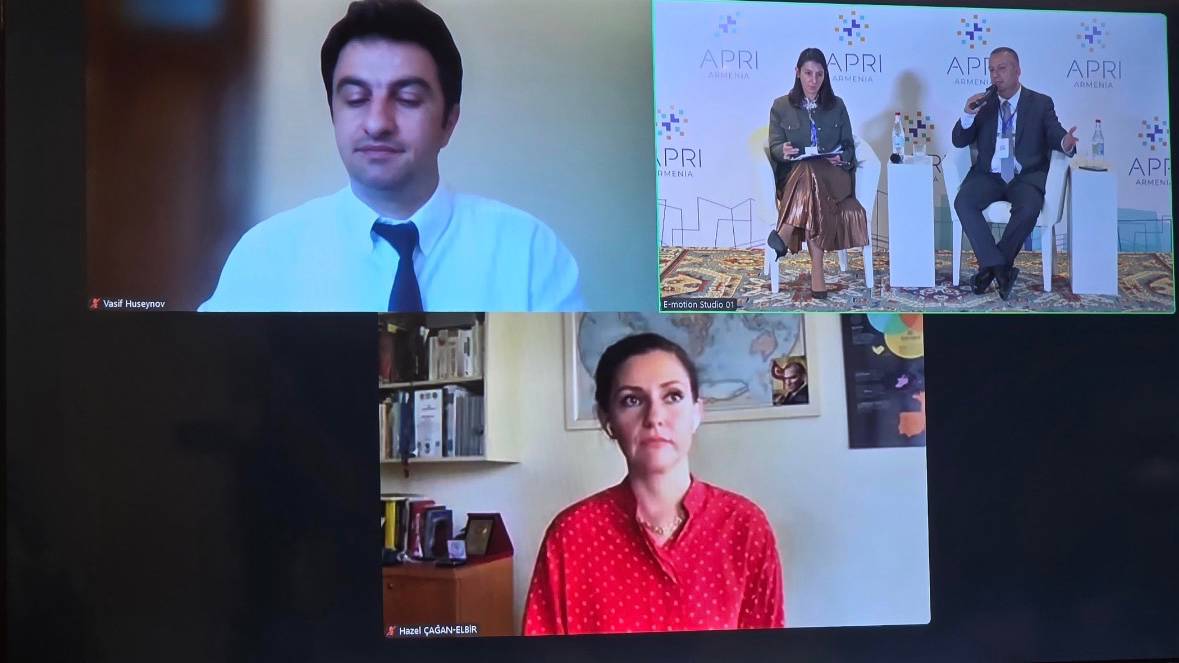
This year’s forum of the Yerevan based think tank APRI Armenia, held in Armenia on September 23–25, was themed “Sketching the Architecture of Change.” I had the chance to attend and follow many of the discussions firsthand. Experts from Armenia, Turkey, Azerbaijan, Iran, Russia and Georgia took part in the forum, some in person and some via Zoom. Participants from Turkey and Azerbaijan contributed via Zoom, while the other participants were present in the hall in Yerevan. The question of the first day was clear: without the peace agreement with Azerbaijan being signed and without the border with Turkey being opened, where will Armenia stand in this new architecture?
After the opening, the first session was a conversation in Armenian with Sargis Khandanyan, chair of the Armenian National Assembly’s Standing Committee on Foreign Relations. Khandanyan recalled that it is taught at Armenian schools that “Armenia is a wedge between different worlds,” but said that today the country’s geography should be seen as an opportunity. In his view, the way to protect sovereignty is to avoid becoming “the point where others’ interests collide” and not to build “exclusive” relations with a single center of power.
Khandanyan: The process is not at a dead end
Khandanyan said he did not share the notion of an “Azerbaijan–Turkey–Armenia vicious circle,” which the moderator, APRI Vice President Anahide Pilibossian, had mentioned in her opening remarks, and that the normalization process with Turkey is not at a dead end. As concrete steps, he listed Turkey allowing Armenia to use the Akhalkalaki–Kars railway, the reconstruction of the historic Ani bridge, the working group set up for the Kars–Gyumri railway, and the business forum that has now been held twice. “But this is not enough,” Khandanyan said. “Turkey should have opened its border with Armenia and established diplomatic relations long ago.” Asked whether he believes in the process, he replied: “I do, because if I didn’t, it would be difficult to work in this direction.”
Khandanyan also spoke candidly about relations with Russia. Recent events, he said, have proven that “Russia is not and cannot be Armenia’s security guarantor,” but this does not mean a break in relations. He added that the TRIPP route (Trump Route for International Peace and Prosperity), which will run through southern Armenia to connect Azerbaijan with Nakhchivan, is a major opportunity for Armenia to break out of the blockade, but that problems will arise if it remains “the only functioning project.”
The US–Armenia session that followed focused on the economic side of the relationship. Luiza Ayvazyan, who heads the Armenia office of the Center for International Private Enterprise (CIPE), said that political agreements alone are not enough and that investors want to see predictable rules. Noting that the most serious gap the private sector sees lies not in the laws but in their implementation, she said: “What we need to learn is how to implement these very nicely written laws in reality.”
“Interest may decline after the US midterms”
According to Armen Sahakyan, Armenia Country Director of the Armenian Assembly of America, who moderated the conversation, Armenia–US relations are in many respects living through their “golden age,” but one has to be prepared for Washington’s interest to decline after the midterm elections in November. Sahakyan noted that many of TRIPP’s details are still unknown, while the two countries’ strategic partnership charter explicitly mentions the Gyumri–Kars railway.
Iran’s conditions on TRIPP
The day’s other sessions were very important in terms of showing the stance of the powers around the Armenia–Azerbaijan–Turkey triangle. Iran’s Ambassador to Armenia, Khalil Shirgholami, said that Tehran does not oppose TRIPP on two conditions: that Armenia’s territorial integrity is not harmed and that there is no US military presence in the region. Andrey Kortunov, former director general of the Russian International Affairs Council (RIAC), offered his interpretation of Putin’s phrase “civilized divorce.” As Armenia turns toward the European Union, Kortunov said, it is ceasing to be a “family member” for Moscow and becoming “rather a neighbor — not even a next-door neighbor as Russia does not have a border with Armenia.”
The “vicious circle” debate
The most heated session of the day was the Armenia–Azerbaijan–Turkey panel, where the concept of the “vicious circle” was directly scrutinized. Pilibossian defined the concept as follows: Azerbaijan makes the signing of the peace treaty conditional on a change to Armenia’s constitution, while Ankara ties normalization to the signing of that treaty.
According to APRI’s Benyamin Poghosyan, who introduced the concept, there has been no breakthrough. It is September 2026, and there is still no peace treaty between Armenia and Azerbaijan. Even the understanding reached between Ankara and Yerevan in July 2022 on partially opening the border to third-country nationals and diplomatic passport holders has gone unimplemented for four years. In Poghosyan’s view, “the Armenian government has done even more than it probably should have to satisfy Azerbaijani demands and the Turkish vision.”
AVİM: The real problem is not Turkish inaction
Hazel Çağan Elbir of the Ankara based Center for Eurasian Studies (AVİM), who joined the meeting via Zoom, disputed this picture: “The record does not support that, really. Turkey has continued to advance the file,” she said. Elbir cited the special representatives, scheduled flights to Yerevan and the railway working group as examples. Ankara, she said, “did not await perfect confidence before opening channels, it generated confidence by acting.” She argued that the real problem is not inertia on the Turkish side but the unfinished legal closure between Yerevan and Baku.
Elbir said Turkey has “no eagerness to be the leader or the one country trying to strengthen its power in the region,” and highlighted one detail: Turkey is keeping its special representative in place, whereas Armenia currently has no active representative. It is worth recalling that Armenia’s representative, Ruben Rubinyan, was elected speaker of parliament in early August, and no successor has been announced yet.
Huseynov: We are taking it step by step
Vasif Huseynov of the AIR Center in Baku also argued that the “vicious circle” label discourages the public: “It is not a circle, it is a linear process, and we are taking it step by step,” he said. Huseynov also added that he thinks the change to Armenia’s constitution could take place within the next few months.
Poghosyan: All borders must open
Benyamin Poghosyan’s main concern, however, was sequencing. Once the Kars–Nakhchivan railway, whose construction Turkey has begun, and TRIPP come into operation, a circular line will emerge, running from Baku to Tbilisi, Kars and Nakhchivan, and back to Baku via Armenia. “Why would Azerbaijan be interested in, for example, opening the Armenia–Azerbaijan border somewhere in Tavush, or the Armenia–Nakhchivan border … if they have this circular railroad?” Poghosyan asked. He stressed that Armenia’s strategic interest lies not in “a hundred meters of the Armenia–Azerbaijan border” but in the opening of all borders, including the one with Turkey.
Huseynov’s own words left this question open. He noted that the launch of TRIPP would mean the opening of at least part of the border in the south, but as to whether all the borders would open, he said: “I cannot say.”
Sharp exchanges over the “Zangezur” name
The debate sharpened when it came to naming the project and the region. Huseynov and Elbir said openly that they use “Zangezur corridor” and TRIPP interchangeably. Elbir drew the distinction as follows: what Baku and Ankara call “Zangezur” is a function, namely unimpeded access to Nakhchivan, whereas TRIPP is the name of “the agreed operating system: Armenian territory, Armenian law, reciprocal use, and a United States development role.”
“Trump’s name works as a deterrent”
Elbir also put a question to the Armenian side: “Is it better for you to name it with the name of Trump, who is not from the region?” Poghosyan first restated the Armenian position: “We are not fully confident what TRIPP is, but we are confident that TRIPP is not an extraterritorial corridor.” He then explained that, as it is perceived in Armenia, bringing in the Americans and putting Trump’s name on the route serves as “a sort of deterrent” against the possibility of Azerbaijan opening the road by force — at least as long as Trump is in the White House.
Alex Petriashvili of the Georgian Foundation for Strategic and International Studies (GFSIS), who came from Tbilisi, repeated the phrase of the day in the last session before the lunch break: “Please come out of this vicious circle, break this vicious circle. We are more than happy to facilitate.”
Imagining a border without fences
The day’s second-to-last speaker was curator Nairi Khatchadourian, founder of the Yerevan-based AHA collective. She described growing up in Paris, where a border was little more than a highway sign, and said that in Armenia, where she has been living for more than eleven years, borders shape every aspect of life. “Whether it is closed off with barbed wire or opened to trucks, the result is the same: people remain apart,” she said. For someone who has spent decades staring at a fence on the banks of the Araks, Khatchadourian said, the other side stops being a place where human beings live. “For generations across the South Caucasus, borders have dictated whom we are allowed to imagine,” she said. She also told the story of a resident of Armenia in a border village, from where the Araks and Iran on the opposite bank can be seen without a wire fence, planted fruit trees such as pomegranates and figs on a rocky slope and opened the garden to everyone, and that those who sit under the trees and eat fruit see the cars going along the highway on the opposite bank and the farmers at work. In Khatchadourian’s telling, at that moment the neighbor on the other side stops being an invisible threat and becomes someone living under the same sun, in the same valley, breathing the same air.
Khatchadourian proposes connecting this garden, by a bridge over the Araks, to the orchards on the Iranian side: a bridge that people could walk across without hurrying. Returning to the forum’s theme at the end of her talk, she said: “Before any architecture of change can be poured in concrete or welded in steel, we must design it in our collective imagination.”
Most of the talk at the forum was about roads: railways, corridors, which step should come before which, what name a road should bear. All of this matters for the region’s future. But in these debates, the people living on either side of the border were mostly left on the margins. Even the 2022 agreement that Poghosyan recalled covers only third-country nationals and diplomatic passport holders; ordinary citizens of Turkey and Armenia are excluded even from that small step, which has been awaiting implementation for four years. As the Ani bridge over the Arpaçay (Akhurian) is being rebuilt, the question I believe we should be asking is whether people, too, will one day be able to walk across it. If border gates open only to trucks, then even if the vicious circle is broken, people will, as Khatchadourian put it, stay apart.


