


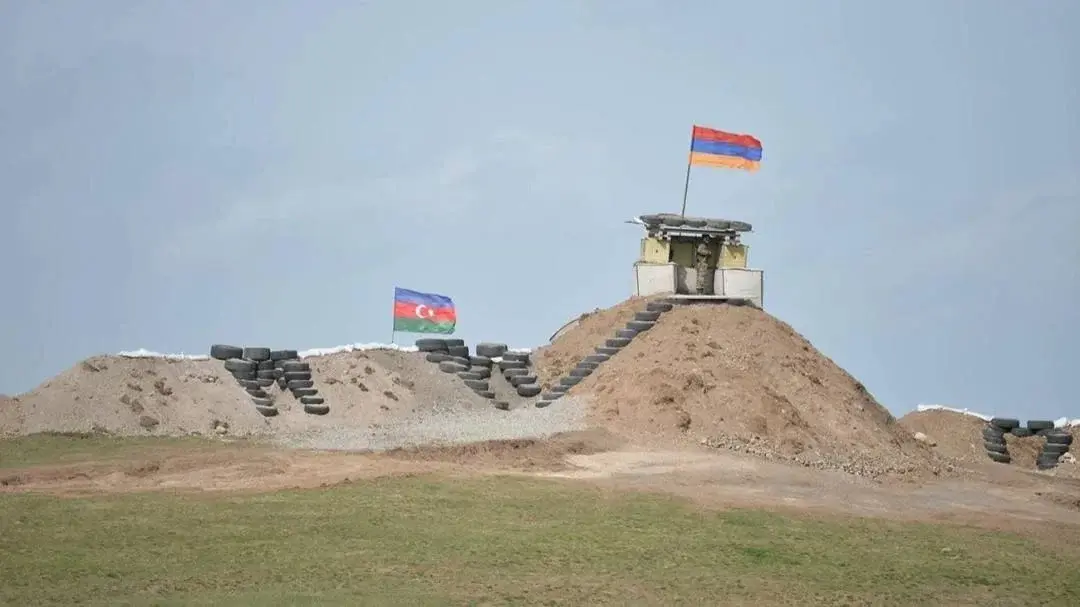
While writing about the APRI forum last week, I noted that the problem in the Armenia–Azerbaijan–Turkey triangle was discussed in terms of a “vicious cycle.” Azerbaijan wants Armenia’s Constitution changed for the peace agreement to be signed. Ankara, meanwhile, ties full normalization with Armenia to the completion of the peace process with Baku. The question on the panel was which step should come first. What happened in Shaki, however, made public perceptions of security a more visible link in this chain.
In this respect, the case of Azerbaijani soldier Nasimi Musayev carries a political significance that goes far beyond the scale of the incident itself. Musayev crossed the border illegally, made his way to the village of Shaki in the Sisian area of Syunik province, and on October 1 entered a house and shot a woman living in the house in front of her children. Baku said the soldier had left his unit in the Lachin direction without permission on September 26, while the Armenian side said Azerbaijani security services had informed it on September 29 of a possible border crossing. Even so, the soldier managed to reach Shaki. It is still unclear exactly when he crossed the border, just as the question of why the people of Sisian were not warned during the two days between the notification and the attack remains unanswered.
Azerbaijani soldier who crossed the border
The issue here is not whether Musayev was sent by Baku. The available information does not suggest so; indeed, the Azerbaijani side has itself opened an investigation, treating the case as desertion. The real problem is how the incident is perceived in Armenia. For a year now, the government’s core message has rested on the claim that “peace is now a reality.” Only a week earlier, at the UN General Assembly, Prime Minister Nikol Pashinyan had said that for two and a half years there had been no casualties or injuries from cross-border fire, and that this was “the greatest value” created in recent years.
The Shaki incident, however, demonstrated the fragility of this discourse. At this point, the fact that an Azerbaijani soldier could cross the border and reach a village house raises a simple question about the claim “there is peace”: Then how was the border crossed?
This question is extremely useful for the opposition, because it feeds an already existing narrative against the government’s new constitution project: “You are fulfilling Baku’s demand.” Pashinyan himself acknowledges that Azerbaijan has instrumentalized the debate over a new constitution, but he says the issue has been on Armenia’s domestic agenda since 2020.
Baku, however, tells the same story differently. According to Ilham Aliyev, the obstacle to the peace agreement is Armenia’s Constitution. Once it is amended, the agreement could be signed the next day. Aliyev’s special representative, Elchin Amirbayov, said in Bern on October 3 that for peace to be “irreversible,” the inconsistency between the constitution and the agreement must be removed.
Opposition's “swap” demand
This creates a strong political connection, even if not a direct legal one, between the security failure in Shaki and the constitutional referendum. Asking citizens to approve constitutional change “for peace” while an armed soldier manages to cross the border strengthens the opposition’s question: “What have we received in return?” The Strong Armenia Alliance answers it with “Concessions are taking us further away from peace.” Its parliamentary group leader, Narek Karapetyan, took the incident to the Parliamentary Assembly of the Council of Europe (PACE) the next day and recalled the Ramil Safarov case. The Armenia Alliance and the Dashnaktsutyun (ARF) camp, for their part, demanded that the soldier not be returned as a “gesture of goodwill” but instead be exchanged for Armenian prisoners held in Baku.
Clearly, the more the referendum looks like Baku’s demand, the harder it becomes to get it approved. Moreover, even getting to a referendum is not straightforward. It requires 70 votes in parliament, and Civil Contract holds 64 seats; in other words, at least six votes must come from the very opposition that took Shaki to PACE. The government would also need to persuade at least one quarter of all registered voters—around 627,000 people—to vote “yes.” That is equivalent to roughly 86 percent of the votes it received on June 7.
Steps that could be taken
And this is where the rest of the chain begins.
If the new Constitution fails at the referendum or the process is prolonged, then under Baku’s current position the signing of the peace agreement may also be delayed. On the Turkish side, Foreign Minister Hakan Fidan said in June that normalization with Armenia was being pursued in “close coordination” with Azerbaijan. This makes even items that could move ahead on technical grounds, such as the Gyumri–Kars railway, dependent on politics. A direct-trade arrangement was even put in place in May; yet goods still pass through a third country, and only their paperwork can mention Turkey or Armenia. As Benyamin Poghosyan pointed out at the APRI forum, even the understanding reached in July 2022 on border crossings by third-country nationals has gone unimplemented for four years. Holding back a decision that requires neither rails nor a tender show that the problem is not technical. Infrastructure is being brought right up to the gate on both sides, but the political switch has yet to be turned on.
After Shaki, the problem is no longer just whether the process is linear or cyclical, as was debated at the APRI forum. Every new security incident further weakens the first link in the chain, namely society’s trust in peace. The weaker that trust, the harder the referendum; the harder the referendum, the longer the peace agreement is delayed; and the longer the agreement is delayed, the longer the border with Turkey stays closed.
The paradox is that keeping the border closed also makes it harder to show Armenian society what peace can actually change in everyday life.
Perhaps for this reason, the issue facing the three countries is not which step to take first. At some point, this chain needs to be broken somewhere by taking political risks. Otherwise, a single soldier, a single border violation, or a new crisis will continue to make a peace that is becoming increasingly institutionalized on paper appear questionable once again in the eyes of society.
The first link is in Yerevan's hands; it can establish an early warning system covering border villages without waiting for Baku. Such a system might not prevent border violations, but it would make the government's "there is peace" discourse testable on the ground. It would also provide an institutional response to the question of why residents were not warned in cases like Shaki, helping to restore public confidence in border security.
For Baku, the "sign now, ratify after the constitutional amendment" formula proposed by the International Crisis Group a year ago stands as an option. From Baku's perspective, signing the agreement and postponing ratification until the referendum could be more advantageous than maintaining the status quo. Such a signature would make Baku’s commitment to peace visible without requiring it to abandon its constitutional condition.
Ankara could also break one of these links. Instead of leaving the entire file to Baku’s timetable, it could separate out the step agreed upon four years ago. This would neither ignore Azerbaijan’s concerns nor bring the final decision forward. But it would show Armenian voters that normalization is a reality. And at the referendum ballot box, that could become the strongest argument in favor of peace.


