


Whenever we begin talking about 1915, we find ourselves standing before the same locked door. For years, there has been an ongoing effort to tell the story and investigate what happened. Oral history projects are being carried out, testimonies collected, and libraries filled with material. Some have wanted to confront the truth; others have chosen to continue denying it.
Some people, to put it mildly, deny what happened; others try to write history in reverse. Still others recount the stories they heard from their families and present documents in an effort to prove what took place. Some demand more documents, while others argue that stories passed down from generation to generation cannot be considered documents. Responsibility is shifted from one people to another, and then to other states. After everything that has been told, what is it that we refuse to hear?
What are we trying to protect?
Various reasons may be listed for why the 1915 is denied: “Something like this could never have happened in our glorious history.” “I would never do such a thing. Neither could my ancestors.” “Besides, if we acknowledge it, the Armenians will come and seize our land and property.”
I remember Hrant Dink explaining in an interview that the difficulty Turks have in accepting the 1915 also has something to do with a matter of honor. He was trying to understand how people find themselves caught between what they know about their families, their ancestors, and their country, and the historical truth.
The bond a person forms with the history he has been told is not easily broken. When they hear a testimony that contradicts what they have believed to be true since childhood, they may question the intentions of the person telling the story rather than the story itself. When they see a document, they focus not on what it says but on who prepared it. When someone recounts their family's past, they ask why they are telling it now and what they hope to gain. Coming to terms can be difficult but denial is not an inevitable consequence of that difficulty.
As long as denial continues, a descendant who wants to remember is seen as an enemy seeking revenge. Someone who tells their family's story is accused of attacking the history of the country. Surely, loving one's country does not require believing that no crimes were ever committed in its history.
A piece of paper
Two years ago, I traveled to Moush and Kars with a young woman named Naira. She wanted to see the places where her family's story had unfolded.
Her great-great-grandfather, Kegham, had lost his younger brother in a river while fleeing Moush with another sibling. The seven-year-old boy never made it to the opposite bank. Kegham managed to reach Gyumri alone. Years later, Naira went down to the banks of that same river. She took a handful of soil. She would bring it to her relative in Gyumri.
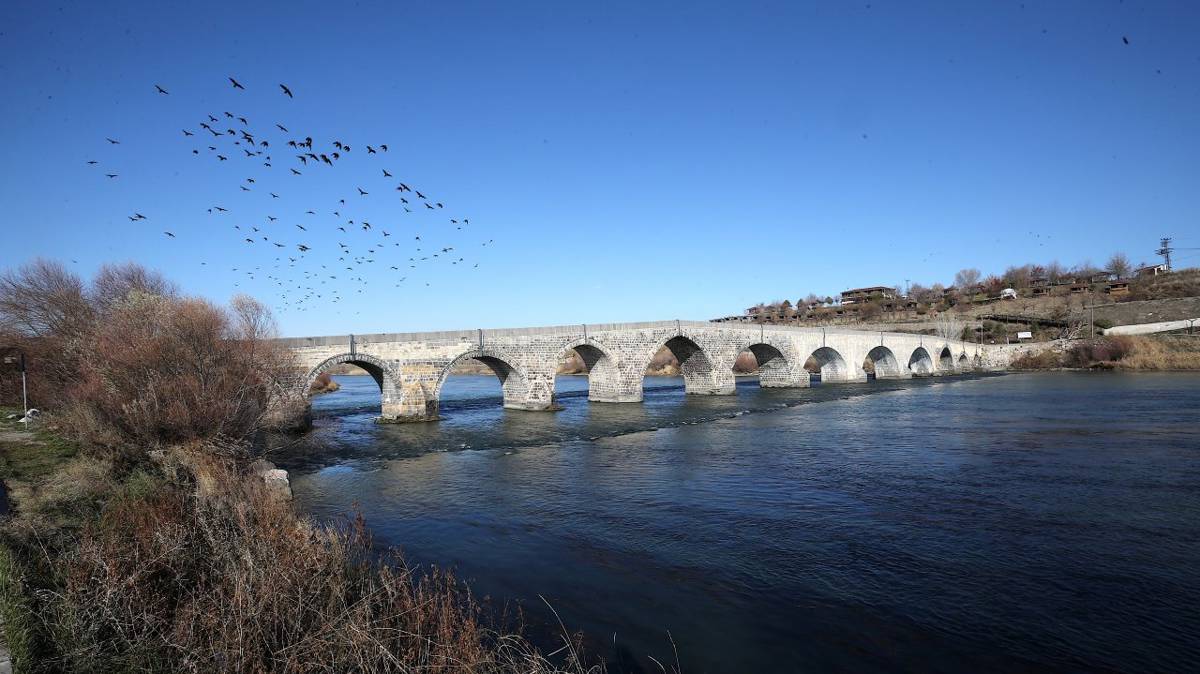
Then we went to Kars. We found Taş Köprü, the Stone Bridge, where her great-great-grandmother, Vartanush, had run and played as a child. Naira ran across that same bridge. Two children had crossed the same bridge a century apart. Then she took a little more soil, this time to place on Vartanush's grave.
There are similar stories in other Anatolian cities. Armenians born in America, Brazil, and elsewhere around the world sometimes set out with nothing more than an old map, a photograph, a document, or simply an address they heard from their families. They search for the houses where their families once lived, trying to recognize a doorstep, a wall, or a street.
They are not dreaming of bringing the past back. They do not even dream of taking those places away or living there. In a place they have never lived, they are searching for the rest of a story that began long before they were born. Because that story is a missing piece of their own lives.
During the same journey, I came across another story about the historic Murat Bridge in Moush. According to local legend, a wealthy Armenian woman had the bridge built and buried a pot of gold in one of its abutments. It was said that the bridge had been damaged by people trying to locate the gold. Throughout Anatolia, one can hear stories of treasure hunters searching for gold supposedly left behind by Armenians. Old sketches, markings, buried treasures…
On one side, there are people following an old address or photograph, searching for traces of their families. On the other, there are people digging into the earth with a sketch they believe will reveal the location of gold left behind by Armenians.
Both have a piece of paper in their hands.
I think of the handful of soil Naira took from the bridge. That soil, which she took just as it was, without wondering what might be buried beneath it.
The letter in the stone and the bones in the garden
Years ago, I went to the Arapgir district of Malatya for a project conducted by the Hrant Dink Foundation. We conducted oral history interviews. Where the old Armenian church once stood, there was now a school. In the school's stone building, I saw stones bearing Armenian letters. They had most likely been removed from the church and reused in its construction.
We struck up a conversation with the school's caretaker. When he learned who I was, he pulled me aside and lowered his voice.
“I'm trying to plant something in that garden,” he said. “But nothing will grow. I keep digging and digging, and bones keep coming up.”
Then he added:
“You left, but we were finished off too.”
Over the years, I have read a great deal about 1915: testimonies, archival documents, historical research, parliamentary resolutions… Each has its own place and significance. Yet none of them has meant recognition of the suffering my people endured as much as that single sentence spoken by the man from Arapgir whose name I can no longer even remember.
That story is my story. It has been carried across four generations until it finally reached me. I feel anger, and I feel hurt. I am angry about what happened in my country, about the denial that continues to this day, about the hatred directed at other people, and about the injustice.
That story is also the story of the man from Arapgir. He, too, feels anger and hurt. What those forced to leave experienced is not the same as what those left behind experienced. Yet in his words there was an acknowledgment of the loss of a life once shared together. I wish he did not have to pull me aside and speak in such a hushed voice.
And then what?
Sometimes I wonder: What if all the Armenians had left? What if not a single one remained? What if there were not even an Armenian school, a church, or a cemetery left in Istanbul? If, in the absence of Armenians, peace had come to those lands, and children had been able to grow up without learning to hate one another, one might almost have been willing to accept even that.
But wouldn't someone else have been found after the Armenians? Another people, another faith, another language… Wouldn't the very existence of one group once again be presented as a reason for another group's discomfort? It is still happening today.
I think of the garden of the man from Arapgir. Of the bones that appear every time he digs into the earth…
I know that some people reading this article will immediately ask: “How did you conclude that those bones belonged to Armenians?” There will also be those who claim that they belonged to Turks killed by Armenians.
But that was not the point for either me or the man from Arapgir. Not a single word passed between us about whose bones they were. Because the issue was not establishing their identity; it was recognizing that the abundance of a shared life that once existed on those lands was now gone.
So, when will that land finally make peace again with the people who live upon it?
If not on the day when the man from Arapgir can speak to me without pulling me aside, without lowering his voice, then when?


