Colonial Order: The Time of Patriarchy and Whiteness


In The Wretched of the Earth, Frantz Fanon carefully explains how colonialism produces a total upheaval in the life of the colonized subject. He shows, case by case, how the violence of the colonizer inflicts psychological, psychiatric, and bodily wounds that are often irreversible. He wrote this in 1961—sixty-five years ago.
Those who believed that things would improve simply with time, without perpetrators taking responsibility or reckoning with the consequences of their actions, should now understand that time that is not dedicated to transformation does not heal anything.
The Epstein criminal network is one of the most significant proofs of how colonial violence—long ignored—organizes and reproduces itself over time.
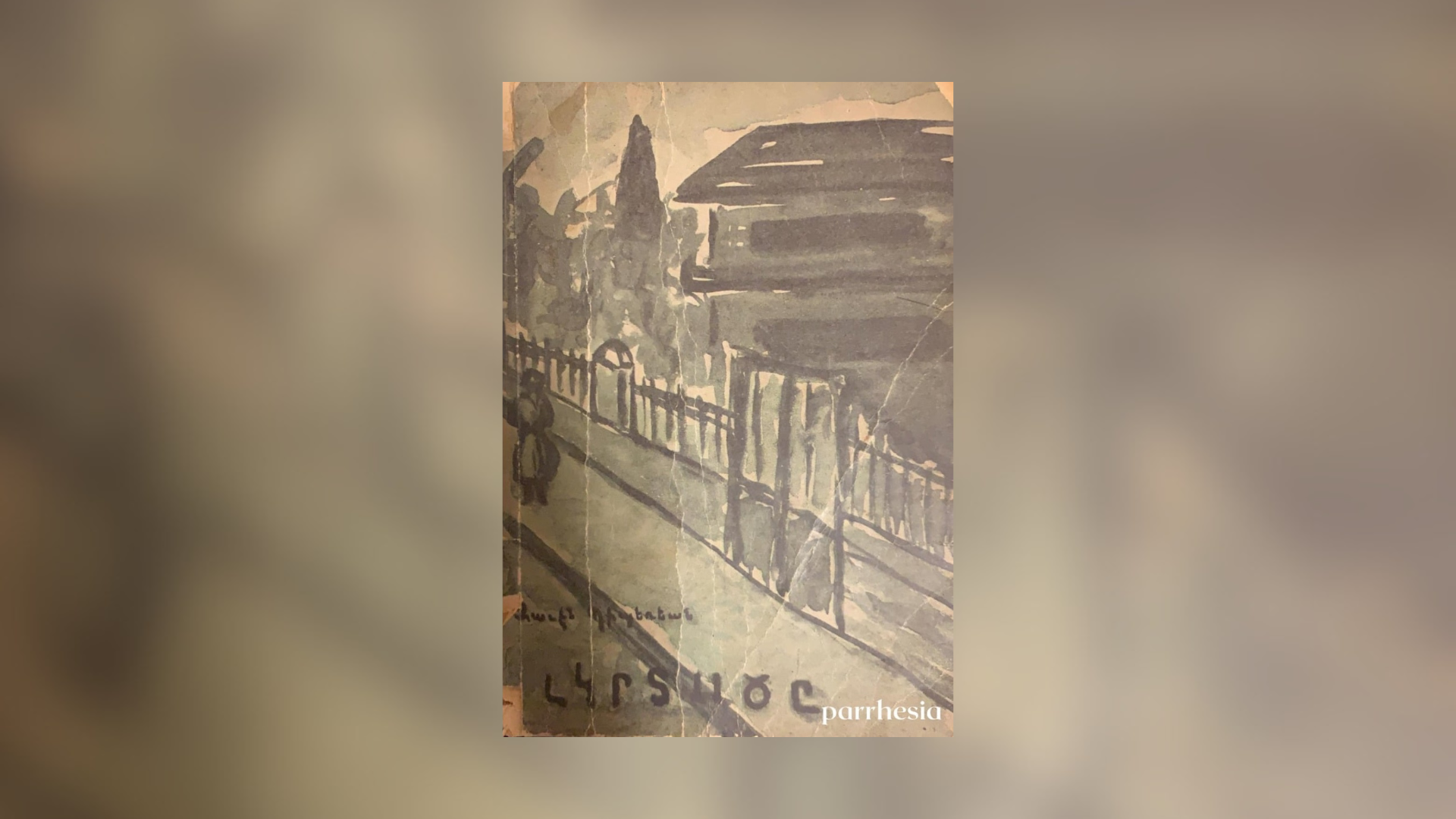
When the Parrhesia Collective began its first social media posts in 2021, it organized a year-long series of readings, discussions, and webinars on Zaven Biberyan. On the occasion of the author’s centenary, we read and discussed his works extensively. In Biberyan’s novel The Lonely Ones, he tells the story of a young woman who, as a child, is placed as a foster child with a large family and who cannot even claim her own name. We do not know her family background, and there is no explicit marker identifying her as Armenian, yet Biberyan is clearly telling the story of tens of thousands of Armenian women and children.
In The Lonely Ones, written in 1959, Biberyan depicts a social reality in its most violent form—one he knew intimately. As the details of the Epstein files continue to emerge and survivors begin to speak, the importance of the novel as a literary work becomes ever more evident.
What is the connection between Frantz Fanon and Zaven Biberyan? Both were among the most critical intellectuals of their time, producing perhaps the most important works in their respective fields, yet they shared the fate of being marginalized, misunderstood and even criminalized in their own lifetimes.
One died of bone cancer born of suffering; the other died after a life marked by illness and poverty.
Biberyan’s novels in a sense, are breaking the spell. He draws attention to the home as a site of instability, to the family as a potentially dark and violent space. How did Biberyan come to understand colonial order as something that first targets the family itself? How is it that in his work relatives, siblings, parents, and children often appear not as sources of support but as agents of hostility?
The answer lies in the lived experience of Armenians in the nineteenth century. Ottoman policies that deliberately separated Armenians living in kavar (provinces) and in Istanbul, and turned large Armenian families against one another, and that rendered local leadership structures ineffective, produced dynamics whose twentieth-century manifestations Biberyan understood deeply.
In other words, both Fanon and Biberyan, drawing on direct historical experience and intellectual inheritance, placed before humanity some of the darkest realities of the modern world. The primary reason they continue to be ignored is that there is no willingness to listen to, transform, or take responsibility for the realities they expose.
Because in the temporality of whites, the native and the Black do not exist at all.
During one of our weekly Parrhesia Collective meetings, a philosophy student expressed fatigue with repeatedly reading Heidegger and engaging with Heidegger scholarship. In response, others noted how widely the assumption of Heidegger’s importance still circulates in academic circles.
And of course, one question echoed in all our minds: how is it that a “philosopher” burdened by a Nazi sympathy—white, male, European—continues to exert influence across geographies and generations, while Fanon, whose claims are empirically grounded and historically demonstrable, remains difficult to teach in Europe?
The answer, I would argue, is this: Fanon’s difficulty lies precisely in the fact that he directly exposes the destructive effects of colonial order on the colonized subject—and in doing so, he directly confronts Epstein and his equivalents. For this reason, capitalism targets Fanon as “Black,” that is, through the most explicit form of racism.
To this list we could add Karl Marx, Rosa Luxemburg, Silvia Federici and others. As thinkers who expose capitalism at its most vulnerable point, they too have been subjected to processes of criminalization.
Although all these thinkers have illuminated central questions of centuries-old structures of domination, none of them have become standard readings within the Western academy.
We might not have understood or learned this perspective had we not been taught by Harry Harootunian. The fact that Harootunian—descended from an Armenian family from Harput—is one of the most important living Marxian historians is not incidental.
The point is this: what has been written about colonial violence, its organization, and its consequences is not new. Nothing improves simply with time. On the contrary, those who control the time of patriarchy continue to deny the labor and intellectual production of thinkers named here and many more unnamed, forcing all of us into conformity with patriarchal temporality.
The Epstein revelations have created a significant rupture in the time of patriarchy—because this time, the fire has reached the world of whiteness itself.