


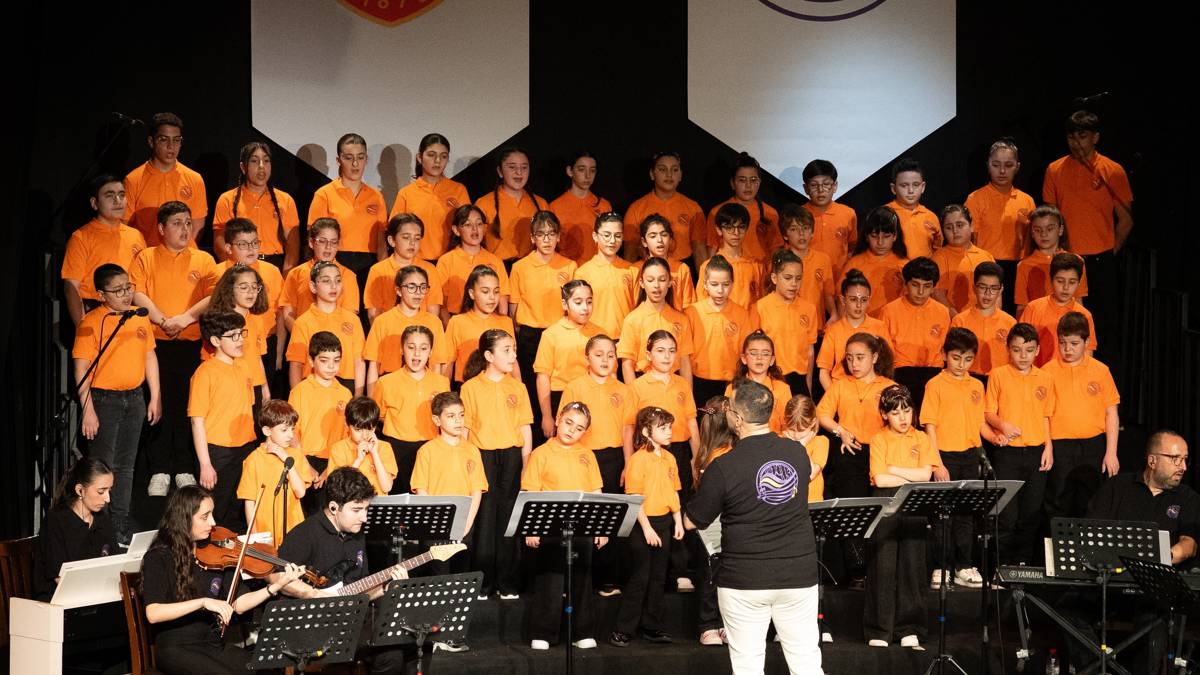
My journey with the children's choir did not begin with a carefully planned dream. I can honestly say that. In fact, it was a door opened by necessity.
At the time, I was working mostly with adults. Polyphonic choirs, church music, traditional repertoire... My mind and energy were devoted primarily to that world. Then one day, when I started to lead a long-established choir, I realized something: sometimes, before you can conduct a choir, you first have to rebuild it.
Finding voices seems easy enough. Finding people does too. But creating a community that is willing to learn together, able to look in the same direction, and ready to question its habits, even a little, is an entirely different matter. After a while, I found myself asking:
"Is it possible to build the future starting today?"
That is more or less how the idea of a children's choir was born for me. At first, my thinking was very simple. If I worked with children and could raise them from an early age with a solid musical foundation, then perhaps a few years later there would be a youth choir that sang more cleanly, listened more attentively, and was more open to learning—and eventually an even stronger main choir. In other words, the children's choir was not, at first, a romantic idea for me; it was a practical investment in the future.
But once I began working with children, the whole picture changed. Or rather, I changed.
The World Beyond the Voice
It did not take long for me to realize that a children's choir was not simply a stepping stone for training future choristers. It was a remarkable world in its own right. One child was learning, for the first time, how to listen to a friend. Another was learning to sing without always trying to make their own voice stand out.
I will never forget one rehearsal. One of our children, around eight years old, softly hummed an Armenian word I had just taught simply because it fit the melody. Then he paused and quietly asked, "Teacher, what exactly does what we sing mean?" At that moment, I realized that the song was no longer just a sequence of sounds for him; it had become a new room he was curious to enter. Another child was frightened before going on stage, but among friends, in that room, she felt safer.
That was when I understood that a children's choir is about far more than teaching songs.
From the outside, it may look very simple: children come, learn songs, perform on stage, and receive applause. But anyone who spends time in the rehearsal room quickly realizes that this is not what it is really about. Sometimes, a child learning to wait patiently for a friend becomes more important than singing the correct note. Sometimes, learning to be silent together is just as valuable as learning to sing together.
A choir gives a child this feeling: "I have a voice, but I am not alone."
That is an incredibly important feeling. Today, many children are either pressured to shine on their own or disappear into the crowd. A choir creates a healthier space between those two extremes. The child hears their own voice while also learning to make room for someone else's.
Gomidas's Legacy and New Breaths
When it comes to a children's choir singing in Armenian, the significance of this work becomes even greater. Because here, a child does not simply learn a melody. They connect with the sound of a language, the memory of a culture, and sometimes the warmth of a word that is no longer heard very often at home. Some children speak Armenian fluently, while others know almost none of it. Yet a song often opens the door to the language more gently. The child first falls in love with the melody. Then they become curious about the word. Then they begin to understand the emotion that the word carries.
Whenever I hear children breathing life into those words, I deeply feel the invisible connection between us and the legacy of Gomidas Vartabed. His collecting, arranging, and reviving folk songs through choral music was never simply about preserving music; it was about ensuring that the voice of a people would not scatter, disappear, or be lost, but would continue to reach new ears.
Today, when I work on Armenian songs with children, I do not see that legacy as something distant. Of course, I am not speaking of the same historical weight, but on a smaller scale I feel a similar responsibility. Every correctly pronounced word, every carefully placed accent, every word that sparks a child's curiosity becomes another thread connecting that collective memory to the present.
Thinking About the Child, Not the Song
Of course, there is an important misconception here. A children's choir is not simply a scaled-down adult choir.
Sometimes we forget this. We want children to sing the songs we ourselves love. But not every beautiful song is suitable for children. A child's voice is different, their breathing is different, their attention is different, and their world is different. Sometimes a piece has to be adapted for children. Sometimes we have to give up a song we dearly love. Because we must think about the child before we think about the song.
The same is true of the stage. Yes, concerts matter. Children see the results of their efforts, receive applause, and gain confidence. But the true magic of a children's choir usually begins long before the performance. It begins in rehearsals. It begins while repeating, making mistakes, laughing, waiting, and listening.
A child may not sing a single note during the first rehearsal. Then, a few weeks later, that same child begin quietly singing among their friends. One day you look up and see them on stage, their eyes shining as they sing the most difficult passage. Someone in the audience sees only that concert moment. But behind that moment lie trust, patience, and countless invisible small steps.
A Breath Left for the Future
Conducting a children's choir that performs Armenian repertoire in Istanbul carries a special responsibility. In this city, Armenian music is not something heard only on stage; it is a living memory that continues in schools, churches, community associations, homes, and in the voices of new generations of children. It is not enough simply to "teach" this memory to children. It must find meaning in children’s inner world, they must come to love it.
The past is immensely valuable, yes. But a repertoire that does not resonate with children's lives today eventually becomes little more than an obligation. Just as important as faithfully passing on old songs is arranging them for children's voices and renewing the culture in their breath. Because culture survives not only by being preserved, but by being sung.
Looking back today, I smile at the fact that my journey with the children's choir began out of necessity. Sometimes a difficult situation leads a person onto the path they were truly meant to follow. At first, I thought I was building the choir of the future. Then I realized that the voices of children today are already a future in themselves.
When a child sings an Armenian song with genuine joy, there is more than music in that moment. There is language, friendship, dedication, and a life that continues.
That, in many ways, is what a children's choir is: carrying a voice from the past into the future through the breath of children today.


