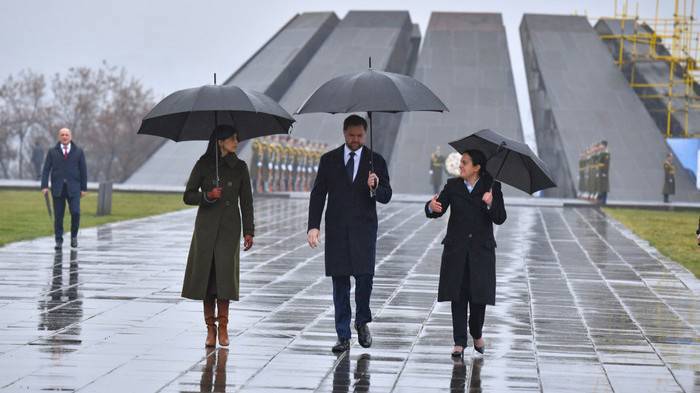


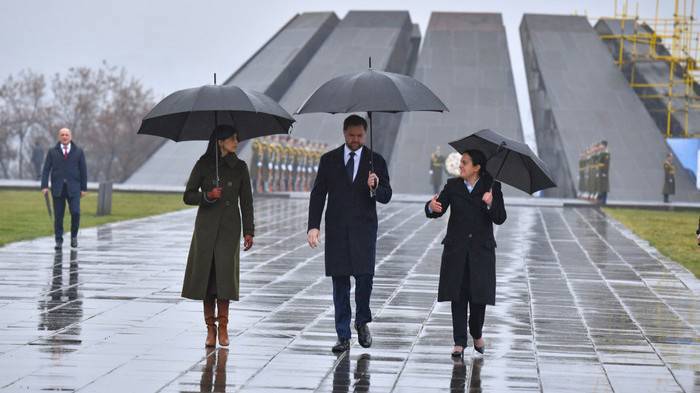
I previously discussed whether the concept of genocide in general, and the Armenian Genocide in specific, had faded into the background of minds and actions due to conditions that have developed both in Turkey and abroad in recent years. Ari Demircioğlu also wrote a very timely article which was published in Agos on May 1 and looked at exactly where one ought to look: the April 24 messages published by Pashinyan in recent years. Thanks to him, my attention was drawn to these messages as well.
Contrary to what some in Turkey claim, Pashinyan has obviously not stopped calling the Armenian Genocide genocide. However—as Demircioğlu pointed out and as shown by the April 24 messages Pashinyan has published since 2022—there is an effort to lower the tone, soften the language, and avoid offending Turkey. Under current conditions, this effort is understandable to a certain extent. But where should the limits of this mentality be drawn?
Let me say from the outset that I find the route Pashinyan is trying to set for Armenia generally correct and reasonable. It is impossible for Armenia to get anywhere by fighting with its neighbors. What will make Armenia more prosperous is peace and the stability it brings. In this regard, it is also right for the Pashinyan administration to seek a lasting compromise with Turkey (and Azerbaijan). Since it is understandable for all parties to make certain concessions or abandon some of their goals in such peace processes, the Armenian government may also make some concessions on this or that issue for a lasting peace. Nevertheless, there must be a red line here—not only for the Armenian government or the Armenians in Armenia, but for every Armenian across the world who maintains even a slight connection to their Armenian identity: not to compromise on the nature of the genocide, and not to (re)produce discourses that may be exploited by denialism. Beyond being a matter of concrete policy, this is also a matter of honor.
In this regard, I believe that April 24 messages should have a specific framework. April 24 messages, especially of the people running the Armenian government, should emphasize the minimum and the essential, and limit themselves to that as much as possible. The essence of the matter is this: Armenians were collectively wiped out from their millennia-old homeland as victims of a systematic evil; they suffered losses that have never been and can never be compensated on various levels; they were socially, economically and culturally set back by the genocide to an incalculable degree; and whatever Armenia and Armenians all over the world are experiencing today, the biggest determining cause is the genocide.
Historical analyses beyond this may be true or false, but April 24 messages are not the appropriate opportunity to discuss historical arguments and counter-arguments. For example, the place to address the question of why/how the genocide happened should not be an April 24 message. For decades, Armenians and non-Armenians as well, in politics and academia, have been discussing these and similar questions and producing works. They will continue to debate and produce. This being the case, one cannot expect these questions to be answered in a one-page text, nor it is necessary to do so. For instance, in his latest statement, Pashinyan draws attention to the role of imperialism in the genocide. To put it in its simplest terms, of course the Great Powers played a negative role in the Armenian Genocide and they bear responsibility; but when you tell this without putting it into context, without explaining its background and aftermath—which is impossible to do in an April 24 message—you lean toward the decades old denialist theses, as if Western imperialism was the cause or the perpetrator of the genocide. There is no need to put forward these interpretations in an April 24 commemoration message just to look sympathetic to your current interlocutors in Turkey.
April 24 should be a day to remember the gravity of the genocide and the magnitude of the loss, a day to observe the necessary mourning; any word beyond this may cause the common denominator to be lost. Similarly, making the genocide commemoration day an occasion to gain advantage in current party rivalry or electoral campaigns, etc., is an attitude that must be avoided, as it weakens the unifying character of the genocide commemoration.
What I am saying does not mean getting stuck on the genocide, diving into a bottomless sea of melancholy and nostalgia, or using the genocide as an active tool in international politics (using the genocide as a political tool is not categorically illegitimate though; it depends on how you do it). Today, the genocide does not need to be the determinant of the direction Armenia will take, or a prerequisite for its relations with other countries—in fact, doing so might even be wrong. Therefore, policymakers or a government may choose not to prefer this way, but they cannot cast a shadow over the spiritual and moral importance of the genocide or the memory of the victims; they cannot present what was done to them as "reasonable" or as a "normal" consequence of the course of events or political choices of the actors of the time, especially of the victims themselves.