
From the moment human beings fall into the womb, they find themselves wrapped in a web of both visible and invisible networks. Their relationships—familial, social, and professional—along with their connections to the land they inhabit, non-human living beings, and ultimately the universe, are shaped within inherited and ever-changing social, economic, ecological, political, and cultural dynamics. Migration, on the other hand, marks the beginning of a new story that completely transforms these networks of relationships through spatial displacement. In this article, I look from the perspective of intersectional feminism at how visibility, labor, and belonging are shaped for different individuals within this network of changing relationships brought on by migration, and how various inequalities intersect.
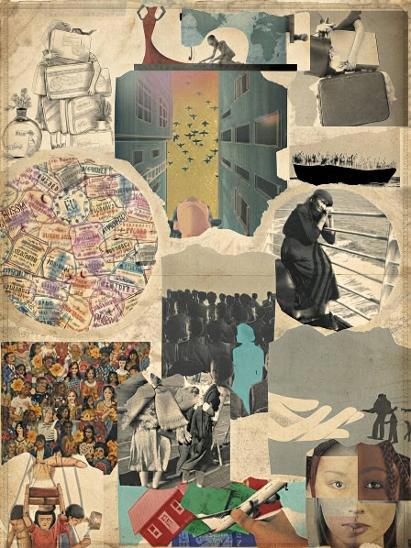
In the process of transforming a new location into a permanent or temporary second home through migration, a person leaves behind their circle of friends, family members, social habits—in short, the ecosystem they are accustomed to—to a large extent. In today's world, the first element that greets migrants in their new country is bureaucracy. Certain skills you have developed over the years in your homeland can suddenly become useless. For example, you might be someone who is social, quick to resolve issues, and accustomed to working and progressing by producing despite most difficulties and impossibilities; yet bureaucracy demands that you wait, and during this process, prove with various documents that you are a socially and economically acceptable subject.
In my own story, I encountered bureaucracy and slow-moving structures just as I realized I had to rebuild my career from scratch in the middle of a void—as an independent artist and educator in the English countryside, where only a handful of people were aware of my work, and where relationships were as distant as the living spaces themselves. Over time, I realized that I needed to keep my pace, style, and goals open to change, and to enhance my ability to adapt. Although most of the professional and structural problems I had to deal with in Turkey vanished here, the decrease in the intensity of feelings such as closeness and belonging began to make me feel that something was amiss.
I paused and tried for a while to make sense of this emerging complexity within English village life, which has very low cultural diversity; I did not know where to start untangling this knotted ball of yarn. Eventually, I decided to snap out of my state of inaction and continue doing the things I knew best and that made me feel good. With the arrival of spring, acceptance letters began to arrive from various festivals I had applied to. This was a cause for celebration! However, while working on the details of the workshops I had designed, I found myself in the middle of a continuous stream of email correspondence spanning months—something I had never experienced before. I spent my days reading and responding one by one to emails for the festivals I was accepted into: risk assessments for workshop participants, sensory risk maps, and files to create additional promotional visuals to support workshop publicity—requests I was not used to being asked for in Turkey. As my body rebelled against the process, I fundamentally realized that I had to meet bureaucratic expectations at this point as well.
During those days, alongside my new experiences in the triangle of artistry, instruction, and labor in the UK, I also recalled my experiences in Turkey. While some arts and culture organizations that expect flawless service from you can duly compensate artists and educators for their labor and time, others cannot—or choose not to—meet this obligation financially or morally. Although offers for unpaid work are less common in the UK, the country where the playbook of capitalism was written, offering unpaid work or proposing compensation far below market value in exchange for "visibility and recognition" is extremely widespread, especially in the art sectors of developing countries. When this exploitation of labor—handsomely packaged and served to you—comes from individuals in positions of power, it is not easy for young or unemployed artists to say "no." We also frequently hear of individuals who demand their rights being bullied and ostracized by these very same powerful figures and institutions under the accusation of "putting money ahead of art." Consider a sector that marginalizes you when you demand a fair living wage for your labor, while the exact same individuals or institutions share their demands for the right to life, gender equality, nature conservation, justice, and the like with society through both their rhetoric and events, thereby preserving their relatively privileged and enlightened status. So, what makes this contradiction possible and persistent? The permission granted by the relevant administrations to all of this, and the silent majorities who do not know their rights and do not demand them...
Meanwhile, the bureaucratic structure uses intermediary actors—both in the context of management and public relations—who polish and present events in order to create the illusion that things are running smoothly, to render existing injustices invisible, and to convince everyone that everything is fine. French sociologist and philosopher Pierre Bourdieu, who researched how systems of culture, power, class, and education reproduce inequalities in society, viewed art as a contentious battlefield and spoke of an elite group called "gatekeepers" who decide who ascends in the art world and how. These gatekeepers—who deliberately ignore the labor of some, surprisingly give others their full due, continue to exploit the labor of others in the background, and stall a segment of artists with the myth of "if you are good enough"—hold fixed positions spanning many years in the same or similar institutions. However, they are losing their power compared to the past, thanks to a new culture of seeking rights, exposure, transparency, and solidarity.
Yet the world is in a transition period; even if slow, the system is transforming, and everyone's choices matter. Are we standing in solidarity with traditional spaces that enjoy regular structural support, refuse to confront their past, and are unwilling to give up their role as kingmakers behind a rhetoric of solidarity? Or are we supporting disadvantaged, alternative institutions and artists who cannot receive the support they deserve from the system for their labor and are rendered invisible?
And more importantly, how can we liberate ourselves from the philosophy of a system that governs us by dividing us, and move forward without falling into the discrimination of "one or the other"? I believe we can re-examine these questions in the light of intersectional feminism, a term brought into the literature by law professor Kimberlé Crenshaw. This approach advocates for a fair, pluralistic, and diverse life practice not just for a specific group, but for everyone—placing at its center the unique disadvantages brought about not only by being biologically a "woman," but also by belonging to a different race or ethnicity, having a different sexual orientation, or being a migrant. In this context, the centralized, non-transparent, and discriminatory bureaucratic structures I exemplified above cannot serve intersectional feminist ecosystems. In the arts and culture environment, however, curatorial choices can reflect the values of intersectional feminism; to give an example, despite all their bureaucratic weight, the festivals I participated in with my workshops this spring truly possessed inclusivity and diversity.
As I conclude my writing, I would like to remind us that whose voices we hear today and whose creations we see—or fail to hear and see—continue to shape not only their lives, but also our own lives, dreams, and intellectual worlds.


