

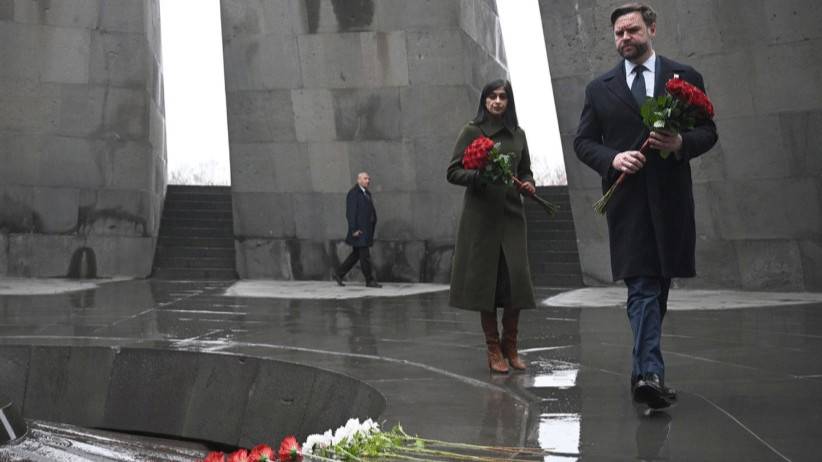
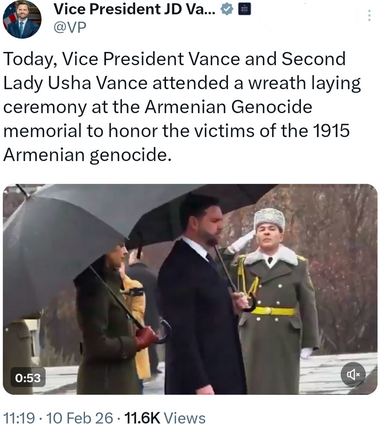
The deletion of the tweet—which used the word “genocide” following Vice President JD Vance’s visit to the Tsitsernakaberd Armenian Genocide Memorial in Yerevan during his trip to Armenia—has sparked significant controversy. Social media users reacted sharply.
On Tuesday, a message was shared from Vance’s official account accompanied by a photo of the couple: “Today, Vice President Vance and Second Lady Usha Vance participated in a wreath-laying ceremony at the Armenian Genocide Memorial to commemorate the victims of the 1915 Armenian genocide.” However, the message was deleted within an hour.
 Following the deletion, a different tweet was shared by Vance’s press secretary, Taylor Van Kirk, which contained neither the word “genocide” nor any specific context regarding the visit. Tagging the accounts of JD Vance and Usha Vance, the press secretary wrote: “On the final day of their visit to Armenia, they laid flowers at the eternal flame and signed the guestbook.” Vance’s account retweeted this new post. According to a photo shared in Van Kirk’s tweet, Vance wrote the following in the Genocide Museum’s guestbook: “In memory of the lives lost, we gratefully acknowledge the resilience and indomitable spirit of the Armenian people. America and Armenia are working together for a future of peace and dialogue.”
In response to these events, X users accused Vance of deleting the post to appease Turkey and Azerbaijan. Meanwhile, a staff member from Vance’s team told RFE/RL that the deleted tweet had been posted “by mistake” by a staffer who was not part of the delegation.
Answering media questions at the airport just before departing for Azerbaijan, Vance stated in response to a reporter’s question that the memorial he visited was an “important place,” but he again refrained from using the word “genocide.” Vance mentioned that he would also visit “some important places” in Azerbaijan the following day and noted that the Armenian side requested the visit due to the memorial’s importance to them. Vance continued: “It is a very terrible event that happened over a century ago and it is culturally very significant for them. Therefore, I wanted to go and pay my respects as a sign of respect to both the victims and the Armenian government, which is a very important partner for us in the region.”
America’s Stance on “Genocide”
The recognition of the Armenian Genocide by the U.S. has been a subject of debate since the beginning of President Trump’s second term. On the 110th anniversary of the Armenian Genocide, official U.S. institutions avoided using the word “genocide” in their statements, a situation criticized by Armenian media and activists.
The White House’s 2025 statement read: “Today we commemorate the Meds Yeghern and gratefully remember the souls who suffered in one of the worst mass atrocities of the 20th century,” and continued: “Beginning in 1915, 1.5 million Armenians were deported and marched to their deaths in the final years of the Ottoman Empire. On this Remembrance Day, we mourn the many lives lost alongside the large Armenian community in America and around the world.” The expression “Meds Yeghern,” which means “Great Calamity” in Armenian, is frequently used by U.S. politicians to refer to the Armenian Genocide while avoiding the direct use of the word “genocide.”
In 2021, former President Joe Biden became the first U.S. president to use the word “genocide.” Barack Obama, on the other hand, used the word “genocide” before being elected president but preferred the term “Meds Yeghern” after taking office.


